
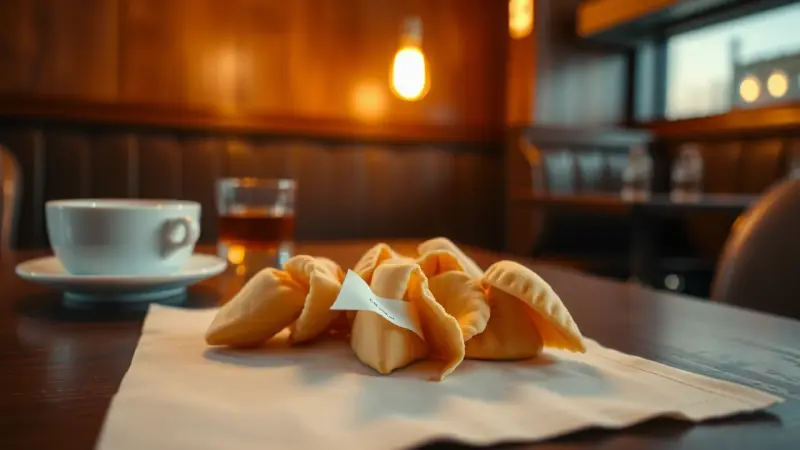
Fortunes are short predictions or pieces of advice. The best-known kind is the slip of paper tucked inside a fortune cookie. A good fortune is upbeat, vague enough to fit anyone and short enough to read in a few seconds. The word fortune can also mean luck, fate or a very large sum of money.
Below you’ll find ready-to-use fortunes for a cookie, a party game or a fortune-teller booth. You’ll also find what the word means in each sense and how the fortune cookie became an American restaurant custom.
What are some good fortunes?
A good fortune is warm, open-ended and personal-sounding without being specific. These original examples work for cookies, gift tags or a classroom jar:
- A door you thought was closed will open again. Patience is already working in your favor.
- Someone is grateful for you today and hasn’t said so yet.
- Your next good idea will arrive while you are doing something ordinary.
- The kindness you give away this week comes back with interest.
- A small risk taken soon will become a story you love to tell.
- You are closer to your goal than it feels.
- An old friend is thinking of you. Reach out first.
- Your hard work is being noticed by the right people.
- Good news will travel a long way to find you.
- Trust the plan you made when you were calm.
What are some funny fortunes?
Funny fortunes play with the format itself: the cookie, the paper, the fake-mystical tone. Keep them light so nobody at the table feels singled out.
- “Help, I am trapped in a fortune cookie factory.” This is a classic gag that works because readers half-expect it.
- “You will be hungry again in one hour.” This one riffs on a long-running joke about Chinese takeout.
- “The fortune you seek is in another cookie.”
- “Today is a good day to finish the leftovers.”
- “You will read this sentence and then reach for another cookie.”
- “Your lucky numbers are the ones on your phone bill.”
- “Ignore the previous fortune.”
- “A great adventure awaits, right after your nap.”
Some diners add a playful phrase, such as “in bed” or “between the sheets,” to the end of every cookie fortune. That’s fine among friends, but skip it at a family dinner or a work lunch.
Fortunes for a fortune teller
Fortunes for a fortune teller are longer than cookie fortunes. They should sound personal while staying general enough to fit almost anyone. That’s how a carnival booth, Halloween party or school fair reading lands well. Speak slowly, pause, and let the guest fill in the details.

- Love: “I see someone who notices you more than you realize. Pay attention to who remembers the small things you say.”
- Career: “A change at work is coming. It looks unsettling at first, but it leads somewhere better.”
- Money: “Your finances are steadier than you fear. A careful choice made soon will pay off later.”
- Travel: “I see a journey, maybe short, maybe far. Say yes when the invitation comes.”
- Friendship: “Someone from your past is about to return. The timing will surprise you.”
- Self: “You have been carrying a decision for a while. The answer you keep coming back to is the right one.”
For any fortunes generator, booth or party game, keep readings positive. Avoid predictions about health, death, pregnancy or breakups. Guests, and especially children, can take them more seriously than you intend.
Which kind of fortune fits your event?
| Fortune type | Typical length | Example | Best for |
|---|---|---|---|
| Cookie fortune | One short sentence | “You are closer to your goal than it feels.” | Takeout, custom cookies, favors |
| Funny fortune | One short sentence | “The fortune you seek is in another cookie.” | Parties, office gifts |
| Fortune-teller reading | Two to three sentences | “A change at work is coming…” | Halloween, fairs, role-play |
| Proverb-style fortune | One sentence | “Trust the plan you made when you were calm.” | Weddings, graduations, notes |
What is the meaning of fortune?
Fortune has three main meanings in English: a very large amount of money, luck or chance, and fate or what the future holds. Context tells you which one is meant.
- Wealth. “They made a fortune selling software.” It also works as exaggeration: “That jacket cost a fortune.”
- Luck. “We had the good fortune to find a parking spot.” Misfortune is the opposite, meaning bad luck.
- Fate or destiny. “The fortunes of the team changed after the trade.” This sense covers the ups and downs of life over time.
- A prediction. “The fortune in my cookie said I’d travel.” This is the sense behind fortune tellers and fortune cookies.
Here is one sentence that uses two senses: She had the good fortune to make a fortune before she turned 30. The first means luck. The second means money.
The word comes from the Latin fortuna, meaning chance or luck. Fortuna was also the name of the Roman goddess of luck, often pictured with a wheel. That image survives in the phrase “wheel of fortune,” the idea that luck turns, and anyone on top can end up on the bottom.
Where do fortune cookies come from?
Fortune cookies as Americans know them took shape in California in the early 1900s. They were most likely adapted from a Japanese cracker called tsujiura senbei, a folded rice-flour wafer with a paper fortune. The cookie later became closely tied to Chinese American restaurants, and it remains far more familiar in the United States than in China.

Who made the first American fortune cookie is still disputed. Competing claims include:
- The San Francisco claim. This account credits Makoto Hagiwara, who served cookies with notes at the Japanese Tea Garden in Golden Gate Park.
- The Los Angeles claim. This account credits David Jung, a Chinese immigrant and noodle maker in Los Angeles.
A modern fortune cookie slip often adds “lucky numbers” and sometimes a short vocabulary lesson on the back. Custom bakeries now make cookies with personal messages, chocolate dipping and sprinkles for weddings, proposals and corporate events.
How to write your own fortunes
Writing your own fortunes takes a few minutes if you follow a simple pattern. Use these steps for custom cookies, a party jar or a DIY fortunes generator:
- Pick a tone. Decide whether the batch is sincere, funny or mysterious. Mixing all three in one batch can feel random.
- Start with a verb or “You will.” Lines like “You will…” or “Trust…” sound like a classic fortune.
- Stay vague on purpose. “Someone” and “soon” let each reader find their own meaning.
- Keep it short. A cookie slip only holds a line or two, so cut extra words.
- Read it as the guest would. Drop anything that could sting, such as weight, age, relationships or money trouble.
FAQ
– What does “fortunes” mean in the Bible?
In English Bible translations, fortune usually refers to a person’s circumstances or prosperity, not a magical prediction. A related phrase about restoring fortunes describes God returning people to well-being after hardship. Wording varies by translation, so check the specific version you’re reading.
– What does the name Fortune mean?
The name Fortune means luck or good fortune. It comes from the Latin fortuna. It is connected to Fortuna, the Roman goddess of chance, which gives the name a sense of good luck and destiny.
– Are fortune cookies Chinese?
Fortune cookies are a Chinese American restaurant tradition, not a traditional food in China. They developed in California and likely drew on a Japanese cracker with a paper fortune folded inside.
– Can fortune tellers really predict the future?
No, there is no scientific evidence that fortune telling predicts future events. Many people still enjoy readings as entertainment, a cultural tradition or a prompt for reflection. Treat them as fun, not as a basis for health, legal or money decisions.